 AyMINE – Technical documentation

Interfaces to other systems
Enterprise Architect Connector
Business excelenece
Balance Scroecards
Task & Project Control
- Send customer answer in regards to the complaint
- Bundle of Documentation and records
- Test and Inspection Management
- Qualification of user or contact
- Project role
- Methodological framework
- Physical and virtual location management
- My areas
- Kanban Task Overview
- Personal Task
- Internal helpdesk
- Customer Care Centre
- Project baseline
- Return project plan by baseline
- Project Schedule
- Processing time sheets
- Project management items
- Activation buttons
- Why some data can't be deleted
- Starting events
- Qualification of user or contact
- task_taskobjects
- Project
- Reminders and Messages
- eventobj_raisingevents
- decision_decobjects
- eventobj_startingevents
- eventobj_eventbuttons
- Hierarchy of testi types
- Deal management
- FMEA criteria for detection evaluation
- FMEA system functionality analysis
- Methodology how to conduct FMEA
- FMEA analysis of the failure occurence
- Analysis of the FMEA Severity
- Support for FMEA Analysis
- Management of responsibilities - RACI Matrix
- RACI matrix for project
- Improvements and Preventive Measures
- Plan
- Notice – example of use
- tskproblem_terminology
- 8D report - quality problem resolution
- Task Scheduling to the right time and scope
- Administration of the Task Management Module
- Adminitration of areas, projects, calendars
- Discussion
- System rights for the task management module
- Project Planning
- Employee Tasks
- Incident and Quality Issue Management
- Collaborative Resolution of Multiple Problems
- List of business areas
- Required qualifications
- Plan template / strategy
- Management and documentation of the decision
- Configuration Package
- Record template
- Change management process in a project
- Task list
- Requirements
- Team Member
- Right to Manage Qualifications
- Obligation
- Competencies and Skills
- Problems, tickets and their management
- Meeting
- Package definition
- Terminology and Nomenclature
- Data Area
- Risk
- Task
- Business event
- Task, project & quality management
- Records and protocols
- Directives and Policies
- Events
- Risk Pattern
- Information
- Project definition
- Activity log
- eventinstances
- Personal calendar
- Objects of decision making
- Event activation buttons
- Objects affected by the problem
- Variant decision-making
- Recorded activities
- Self-Reminders
- Assignment of a New Task According to Methodology
- Objects related to the task pattern
- Effect of the task on the right to modify the atta
- Level of Competence
- Manager approval with the task report
- Region / project / methodology
- Manage your marks
- Task patterns saves work and improve quality
- Management system
- Task planning both in project and daily business
- Project Team
- Events and meetings
- Events and meetings
- List of event instances
- moduleclientoptions
- Processed objects
- Mark patterns
Interprocess management
Human Resources
- roles
- Staffer / Worker Management
- Human resources
- Employee access to the contract files
- Personalistics - User Permissions and roles
- Candidates Management
- Manage department / division data
- Job Position
- Employee dashboard with personal data
- An overview of your staff
- Responsible HR Manager
- Synchronizing staff and system users
- Management of the staffer contracts
- Safety of the HR module
Asset Management
- Products, assets and sales
- Tendering and purchasing
- Analytical model
- Product Supplier
- Product Categories
- Product or Product Property
- Manage projects by goals
- Create offer for premium or B2B clients
- Offers summaries
- Create and recalculate offer using price lists
- Offer and Price Access Rights
- Creating and processing orders
- System order status query
- Order Reports
- Pricing
- Pricing – volume discounts
- Products and Goods
- Product status and change
- Product units
- Definition and Control Quality Criteria
- Why Quality Criteria is a requisite part of QMS
- DFEMA - FMEA of the product design
- HARA for product
Customer Relationship - CRM
- Contacts and directories module (
- System Permissions and CRM Module Settings
- Customer Order Overview
- Address book management and protection
- Address book list and management
- Privacy policy
- Send bulk messages in accordance with GDPR
- Link in bulk message to set preferences or unsubscribe
- GDPR: Support to set preferences over the web
- GDPR: Support for subject forgetting
- Sending Bulk Emails - manual
- Contracts
- Partner in a contract
- Generate messages from system with patterns and AI
- Group of contacts from address books for better management
- Evidence of contacts and related business data
Finance management
System modules
System management
- moduleclientoptions
- Electronic sign even on mobile device
- formattedtexts
- System Configuration
- Processes in use
- Client
- Member Management for churches, non-profit organisations
- Configure gateways for external messages
- Corporate email and communication processing
- Email messages
- Rules for external messages
- Secure business communication
- Sending SMS directly from CRM
- Call directly from CRM
- Documents and files
- Additional functions with files
- Copying and moving files between objects
- Picture presentation
- Public link to the document
- Recent Files
- Dashboard
- Object location on the board
- Client items
- Revisions and comments
- Securing posts and internal discussions
- Translations
- Record Relationships
- Relation types
- System Groups and Teams for rights settings
- User Processes
- System module
- System User
- User administration
- User Administration
- Connecting users to VOIP PBX
- Trusted User Device
- Secure Key Wallet - Safe storage for digital keys
- Data vault for Company secret & Classified data storage
Framework
- AyMINE frm module - corestone of the ecosystem
- Description of the view of the record details
- Private Notes to Records that no one can read
- AyMINE Access control and security
- Introduction to the application
- Using Drag & Drop even on mobile devices
- AyMINE icons are language for fast orientation
- Delete object to the trash
- Principal dashboard
- Settings your own configuration
- AyMINE Gestures and Keyboard Shortcuts
- AyMINE User Rights Control
- Install AyMINE to windows
- About AyMINE
- Work with list of records
- AyMINE on mobile device
- List of records
- How filtering in lists works
- cliplink
- System rights
- Module is the principal brick of the aymine ecosystem
Revisions and comments
Comments and posts on entries are used for revisions as well as finding new solutions.
Comments support internal communication, archive it at the same time and create a long-term knowledge archive from people's experiences.
Did you know that:
- in an average company, most people search for information primarily in email?
- Email inboxes often make up the largest volume of backed-up data
Comments replace part of internal email communication. Compared to which it brings advantages:
- Both posts and messages are retained and will be used in the future, e.g. in case of problem solving
- They can be read by workers who were not included in the original discussion, e.g. because they were not working at the company at the time
- They remain available even if the recipients and senders have left the company.
Efficient use of the discussion is faster, saves time, disk space, but mainly it is also available additionally and not only for direct participants in the discussion.
Don't overlook:
- We write more about effective communication here. Discussions are one of its core parts.
- They also have notifications close to the notes on the records.
- Commenting on objects is not a general discussion. AyMINE supports intra-team discussions.
Methodological note
Discussion posts should be used even if workflows require revisions and checks to be made. Preserving the discussion can be shown later that the revision has actually taken place.
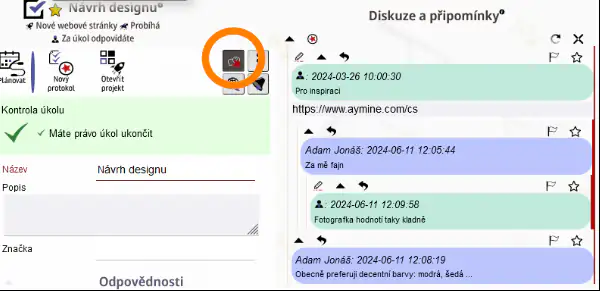
How posts work
Posts relate to a given record – product, asset, request, task, etc. So it is always obvious what they are about. You can create posts in the discussion on a given object. You can open the discussion in the object detail by clicking  . The discussion remains stored permanently on the system, or until the object it relates to is removed.
(A special case is general discussions in the discussion area on the main table. These discussions are separate entries.)
You can address posts to specific people from the company. You can indicate to whom they should be addressed and these users get them on the desktop in the message and discussion bookmark  .
.
New messages are always automatically notified to the people affected by the object in the case of some objects (e.g. everyone on the task team is informed in the task discussion).
If you respond to a post, both the sender and the recipients of the original post are always informed. You do not have the right to exclude them from the recipients.
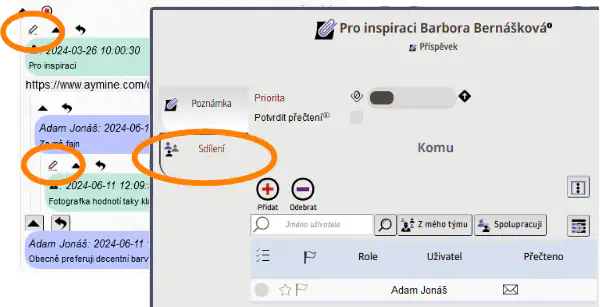
How people find out about a new post
You are informed about a post in a discussion:
- Automatically, the people responsible for the subject of the discussion. E.g. people on the task team, the person responsible for the task in the task in the request
- You can add recipients to a post that receives a notification
- If you are responding to a post, those who were involved in the thread in question will see the post on the main desk.
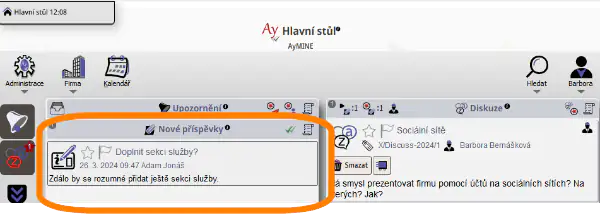
You can see the notification on the main desk under the bell in the New Posts section.
How does a post differ from a notification
Notes and notifications both take the form of a message; however, there are a number of major differences between them:
- Notices are not kept long-term; they are deleted after a year. They are not intended to keep long-term information and experience.
- You always address the notification to one person only, whereas a post may have more readers. Most importantly, posts can be easily read later by anyone who will work with the entry, even if you may not know about it today.
Posts vs. Discussions
Discussions are a separate area, not linked to any other entry. By contrast, posts are always linked to a particular entry, so you can always see them when you work with the entry.